Planning ahead removes a burden from your family at a time of loss.

Most people agree that planning ahead for funeral wishes is a good idea. A written plan protects your family by relieving the burden that falls on loved ones during a time of loss.


Without a plan in place, family members are left with dozens of decisions to make while in the midst of grief. The problem is, many people hesitate to actually create their own plan.

We make it easy.


Check out any of our free resources below or plan ahead online.

Ready to get started?

Plan Online

Free Resources

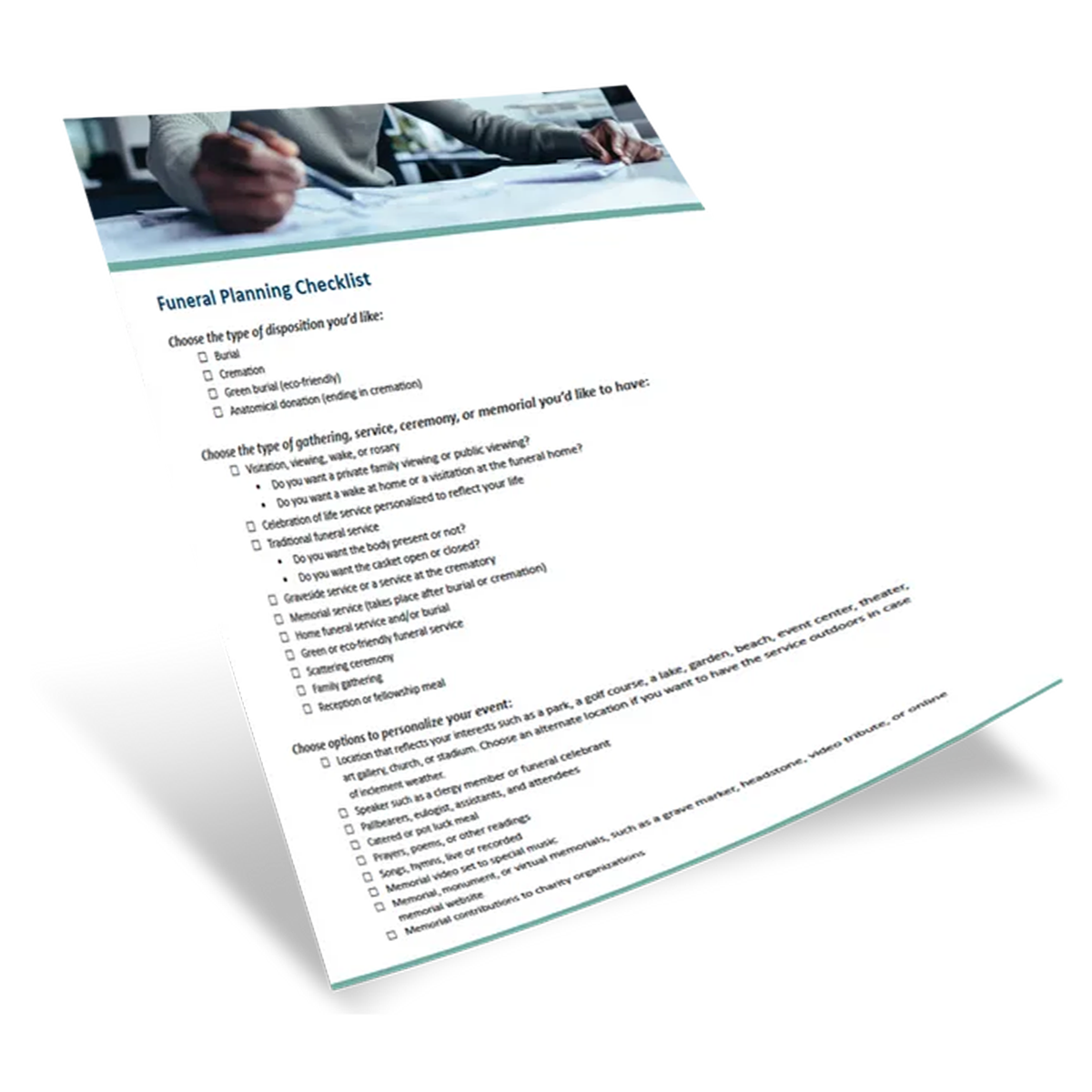
a page of a funeral planning checklist with a person writing on it

Preplanning Checklist


Download this checklist to make sure you aren’t missing any important steps when planning ahead for funeral wishes.

Download checklist
a book titled how to plan a healing and meaningful funeral

"What Are My Burial Benefits as a Veteran?" eBook

This eBook details the burial benefits available for eligible veterans through the VA to facilitate a meaningful funeral ceremony.

Download eBook

Benefits of Preplanning

Makes Your Wishes Known

The death of a loved one often brings about unwarranted stress and turmoil among families. One family member wants one thing, while another family member wants something different. By planning ahead, you help prevent those disagreements by letting your family know what your wishes are and how you want your funeral service to be carried out and your business handled.

Provides Peace of Mind

Preplanning a funeral also provides peace of mind - to you, as well as your family and friends. Knowing that your wishes are understood and that your funeral will be arranged according to your specifications can provide comfort and security during a difficult time. For your family, it can also reduce the stress and anxiety they may feel when making funeral arrangements.

Includes Flexible Funding Options

Preplanning a funeral also offers flexible funding options. You can choose to pay for your funeral in advance or set up a payment plan to spread the cost out over time. By taking care of the cost ahead of time, you can alleviate some of the financial burden that may fall on your loved ones when arranging a funeral.

Relieves the Burden on Family

As you can see, funeral preplanning can have a profound effect on your family. By taking the time to plan ahead, you can ensure that your funeral will be arranged according to your wishes and that your family does not have to make hard decisions during an emotionally difficult time.

Frequently Asked Questions

Common Questions about Preplanning

  • What steps are involved in prearranging a funeral?

    You can make funeral prearrangements in 3 easy steps:


    1) Contact us to get started: Our planning professionals are ready to assist you and walk you through the process step by step.


    2) Select your funeral preferences: Learn about your options, and choose the type of funeral service you desire, including any special requests.


    3) Finalize arrangements: Finalize your arrangement with a payment plan for the services that can be paid in installments. (Setting up a payment plan is not required, but we do recommend it.)


    Book a meeting with our Preplanning Specialist to get started!

  • What information do I need to prearrange a funeral?

    You'll need basic information about yourself or the person you are planning for, such as date of birth, marital status, parents' full names, etc. Besides the biological information, you'll need to choose burial or cremation, what type of service you'd like, what cemetery to use, etc. Our caring staff will help you with this process.

  • Do I have to pay in advance?

    Preplanning is merely making your wishes known; however, most families who plan ahead choose to pre-fund their funeral as well. Doing so will relieve the financial burden on your family and offers peace of mind to you.

  • Can I transfer my plans to or from another funeral home?

    If you have plans at another funeral home and would like to move them here, we will help you do that. If you move away from the area and would like to transfer your arrangements to another funeral home, we will assist you with that as well.

Questions About the Cremation Process

  • What is cremation?

    To start, it might be helpful to clarify what cremation is not. Cremation is not the final method of disposing of remains, nor is it a form of funeral service. Instead, it is the process of using intense heat and flame to reduce the human body to bone fragments.To begin you may contact us, or begin by filling out our pre-planning form. This will start the process of arrangements. Our staff will contact you and walk you through the steps of arrangement. We will discuss cremation options, financing and choose personalized options if desired by you or your family. 

  • How long does the actual cremation take?

    The length of time for cremation depends on the individual's weight. For an average-sized adult, the process typically takes between two to three hours, with the cremation chamber operating at temperatures ranging from 1,500 ºF to 2,000 ºF.

  • What happens after the cremation is complete?

    Once the cremation is complete, all organic bone fragments, which are brittle, along with any non-consumed metal items, are swept from the cremation chamber into a stainless steel cooling pan. Items such as metal from clothing, hip joints, and dental work are separated from the remains through visual inspection and the use of a strong magnet for smaller metallic objects. Dental gold and silver, however, are typically non-recoverable and are mixed with the cremated remains. The remaining bone fragments are then processed in a machine to ensure a consistent size and placed into an urn—temporary or permanent—chosen by the family.

  • What do the cremated remains look like?

    Cremated remains typically resemble coarse sand and are usually whitish to light gray in color. For an average-sized adult, the remains typically weigh between four to eight pounds.

  • In what kind of container are the cremated remains returned?

    To begin you may contact us, or begin by filling out our pre-planning form. This will start the process of arrangements. Our staff will contact you and walk you through the steps of arrangement. We will discuss cremation options, financing and choose personalized options if desired by you or your family. 

  • Are all the cremated remains returned?

    Except for minute and microscopic particles, which are impossible to remove from the cremation chamber and processing machine, all of the cremated remains are returned to the family.

Concerns About Cremation

  • Are there any laws governing cremation?

    To start, it might be helpful to clarify what cremation is not. Cremation is not the final method of disposing of remains, nor is it a form of funeral service. Instead, it is the process of using intense heat and flame to reduce the human body to bone fragments.To begin you may contact us, or begin by filling out our pre-planning form. This will start the process of arrangements. Our staff will contact you and walk you through the steps of arrangement. We will discuss cremation options, financing and choose personalized options if desired by you or your family. 

  • Can two cremations be performed at once?

    The length of time for cremation depends on the individual's weight. For an average-sized adult, the process typically takes between two to three hours, with the cremation chamber operating at temperatures ranging from 1,500 ºF to 2,000 ºF.

  • Can the family witness the cremation?

    No, we do not offer witness cremation services at this time.

  • How can I be sure I receive the correct remains?

    We have established a rigorous set of operating policies and procedures to ensure the highest level of quality and minimize the potential for human error. Positive identification of the deceased is maintained at every stage of the cremation process. Additionally, only certified professionals are allowed to operate our cremation equipment, providing further assurance that the correct remains are returned to the family.

Questions About Urns, Caskets, & Embalming

  • Do I need an urn?

    To start, it might be helpful to clarify what cremation is not. Cremation is not the final method of disposing of remains, nor is it a form of funeral service. Instead, it is the process of using intense heat and flame to reduce the human body to bone fragments.To begin you may contact us, or begin by filling out our pre-planning form. This will start the process of arrangements. Our staff will contact you and walk you through the steps of arrangement. We will discuss cremation options, financing and choose personalized options if desired by you or your family. 

  • Is a casket needed for cremation?

    The length of time for cremation depends on the individual's weight. For an average-sized adult, the process typically takes between two to three hours, with the cremation chamber operating at temperatures ranging from 1,500 ºF to 2,000 ºF.

  • Is embalming required prior to cremation?

    No, embalming is not required prior to cremation, and it is against the law for a funeral home to suggest otherwise.

  • Can the body be viewed without embalming?

    Yes, immediate family members may select to briefly view the deceased prior to cremation at our cremation facility, for an additional cost. The deceased will be washed, dressed, and prepared for a private viewing. However, in certain cases, additional care may be necessary for autopsy remains, organ/tissue donors, or bone donors.

Still unsure? We care for families.

Ready to get started?